NEW & BLOG
Build a highly cohesive team of thermal management, special welding and
precision manufacturing
Joining Aluminum to Copper — and Titanium: How Solid-State Welding Unlocks Busbars, Foldable Phones and Humanoid Robots
Sep. 28, 2026
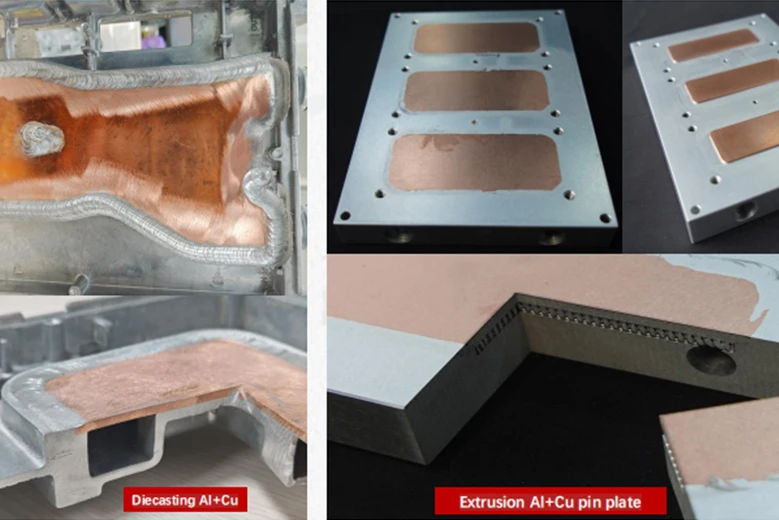
Every hardware generation asks the same question: can we combine two metals in one part — copper for conductivity, aluminum for weight, titanium for strength — without the joint becoming the weakest link?
Fusion welding struggles here. Aluminum melts at ~660°C and copper at ~1,085°C, while thermal expansion rates differ by nearly a factor of two. Melt them together and the interface grows brittle intermetallic compounds (IMCs) that crack under load. This is why Al-Cu busbars, battery posts, and terminal connections have traditionally relied on mechanical clamping or brazing — with well-known limits in contact resistance, weight, and reliability.
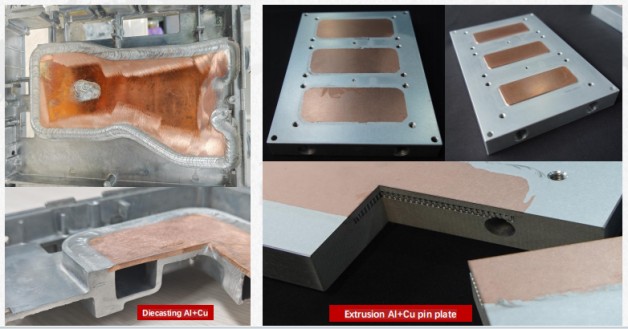
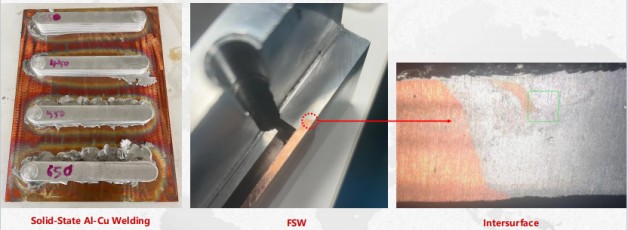
Solid-state joining changes the equation. Friction stir welding and its newer cousin, solid-state composite processing (SCP), join dissimilar metals below the melting point through severe plastic deformation and thermo-mechanical coupling. The IMCs still form — but as fine, dispersed particles distributed through the weld, acting as second-phase strengthening rather than a continuous brittle layer.
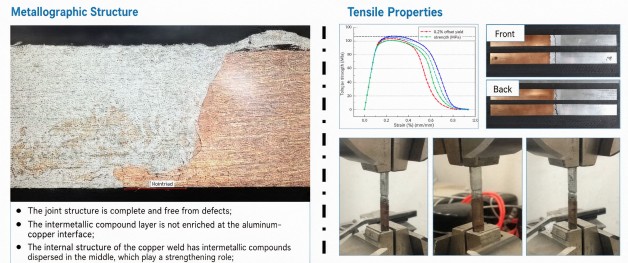
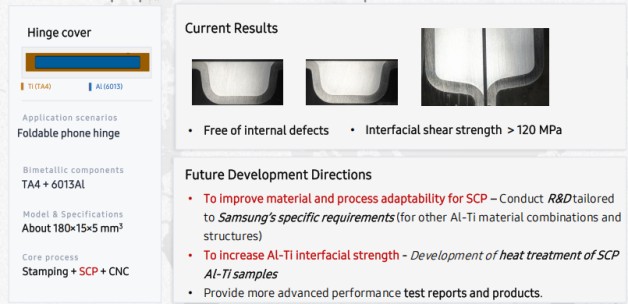
The numbers tell the story. In Deyanfu's Al-Cu solid-state welds, metallography shows a complete, defect-free joint with no IMC enrichment at the interface. Average joint strength reaches 103.9 MPa — 85.6% of the 1-series aluminum base metal's tensile strength — and tensile fractures occur in the aluminum heat-affected zone after necking, not at the joint interface. For Al-steel, joints reach 268 MPa; for Al-Ti, 187 MPa; Al-Ti interface shear strength exceeds 120 MPa.
Where this shows up in real products:
● EV and energy storage. Copper busbars and battery posts joined to aluminum structures, Al-Cu composite cooling plates, and terminal connections where every gram and every milliohm matters.
● Consumer electronics. Foldable phone hinges combining titanium (TA4) with 6013 aluminum in a stamping + SCP + CNC process — parts around 180 × 15 × 5 mm, free of internal defects, with interfacial shear strength above 120 MPa. The same platform enables aluminum coatings on die-cast aluminum and magnesium alloys, and surface treatment of 7xxx-series aluminum — extending corrosion resistance and design freedom in 3C products.
● Humanoid robotics. Knee and elbow joints that must be light, strong, and precisely finished. Deyanfu manufactures these via five-axis CNC machining combined with friction stir welding for deformation-free joining, with integrated one-piece structural design and lightweighting to raise both strength and dynamic response.
● Semiconductor equipment. Three-dimensional welding of dissimilar metals in vacuum chamber components, where joint integrity determines ultimate vacuum performance.
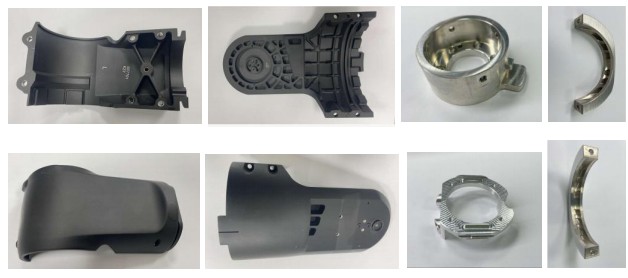
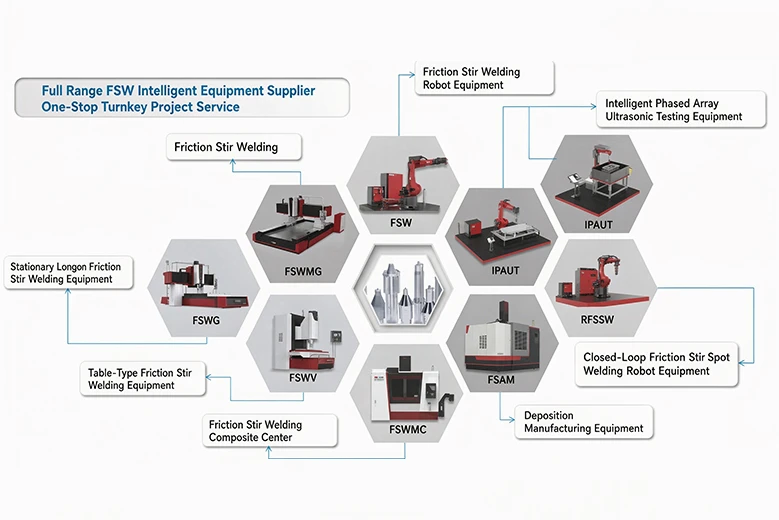
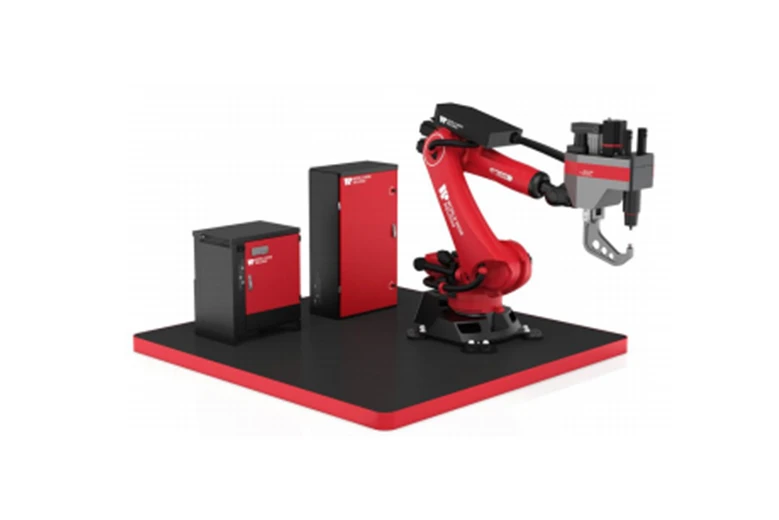
Equipment matters as much as process. Deyanfu claims the world's first self-developed complete SCP equipment lineup — refill friction stir spot welding (RFSSW) machines, 2D and 3D FSW gantry machines, bench and robot FSW systems, FSW-milling hybrid centers, and automated phased-array ultrasonic testing (iPAUT) — providing turnkey capability, not just job-shop welding.
Why sourcing teams should care. A supplier who can join Al-Cu, Al-Ti, Al-steel, and Al-Mg in-house can consolidate multi-part assemblies into single bimetallic components — cutting weight, contact resistance, assembly cost, and failure points simultaneously. That is not a marginal improvement; it is a design option your competitors may not have.
LATEST NEWS
What is friction stir welding (FSW)? How does this solid-state process deliver low-distortion, leak-free aluminum welds for EV battery trays and liquid cold plates? A manufacturer's guide.
Sep.28,2026
From AI Data Centers to 800V EVs: What It Really Takes to Manufacture Liquid Cold Plates
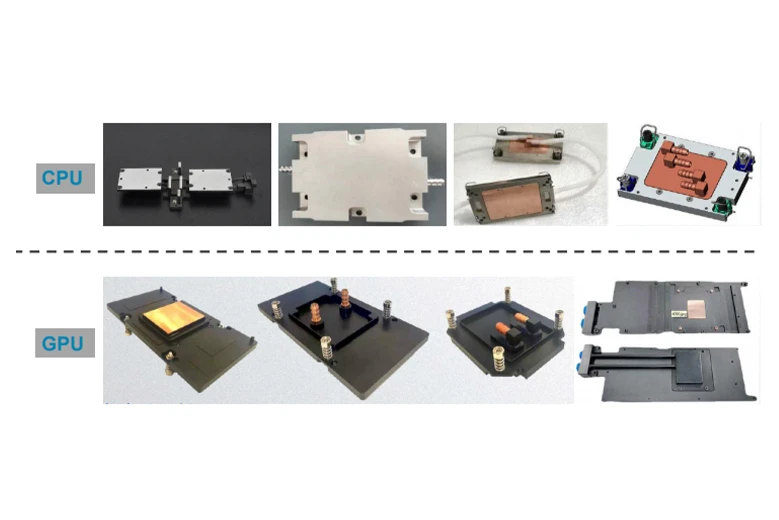
Liquid cooling is going mainstream in AI servers and EVs. A look inside liquid cold plate manufacturing: flow channel design, FSW sealing, burst and leak testing, and mass production.
Sep.28,2026
Every hardware generation asks the same question: can we combine two metals in one part — copper for conductivity, aluminum for weight, titanium for strength — without the joint becoming the weakest link?
Sep.28,2026
Refill Friction Stir Spot Welding: A Cleaner Alternative to Resistance Spot Welding and Riveting
Ask a manufacturing engineer how they join two overlapping aluminum sheets, and the answer is usually one of two things: resistance spot welding (RSW) or self-piercing rivets (SPR). Both work. Both also carry costs that product designers have learned to live with — until a solid-state alternative called refill friction stir spot welding (RFSSW) matured into mass production.
Sep.29,2026
Case Study: Friction Stir Welding ADC12 Cast Aluminum to 6061 Extrusions in a Bus Battery Tray
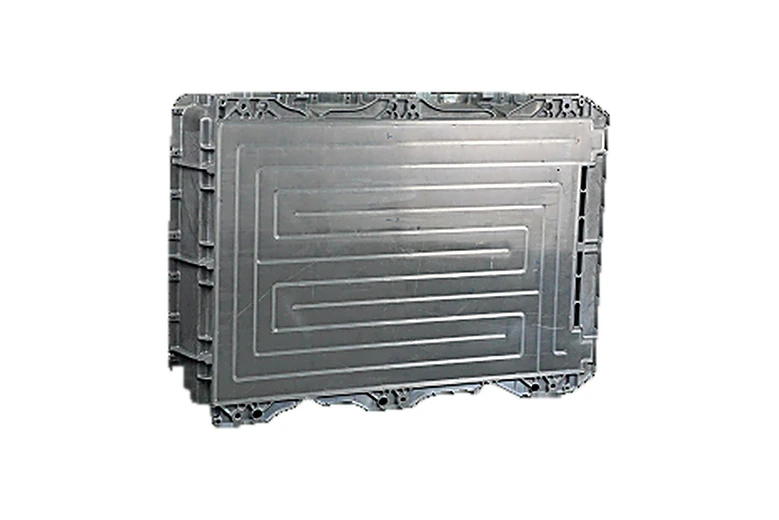
Modern battery trays are a metallurgy puzzle wearing a structural role. The tray must be light, crash-stiff, leak-manageable, and cheap — so designers mix material forms: die-cast nodes and bosses for complex geometry, extruded profiles for rails and frame members, and rolled plate for covers. Each form is easy to make alone. Joining them is the problem, and a recent bus battery tray program shows how one manufacturer solved it.
Sep.29,2026
How to Specify and Accept Liquid Cold Plates: Burst, Pressure Drop, Leak and Thermal Tests Explained
Most cold plate quality disputes trace back to the same root cause: the buyer and supplier never agreed on what "good" means, in test terms. A liquid cold plate can pass a visual check and still fail in the field — clogged channels, creep leakage at a pulse-loaded seam, or a heat-absorbing surface that is out of flatness. Here is the test matrix that serious manufacturers and serious buyers use to align expectations, item by item.
Sep.29,2026
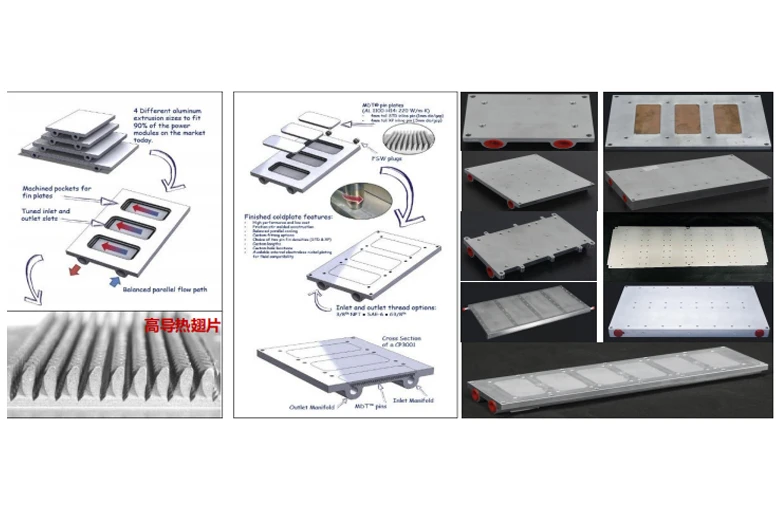
For most of computing history, "thermal management" meant fans. Air cooling defined the shape of servers, the layout of data centers, and the limits of every processor design. That era is ending. AI rack densities that once would have been measured in kilowatts are now quoted in multiples of 100 kW, and no quantity of fans can move that heat out of a rack economically. The industry's answer is direct-to-chip liquid cooling — and its rise is quietly rebuilding a supply chain around a component most data center buyers had never sourced before: the liquid cold plate.
Sep.29,2026
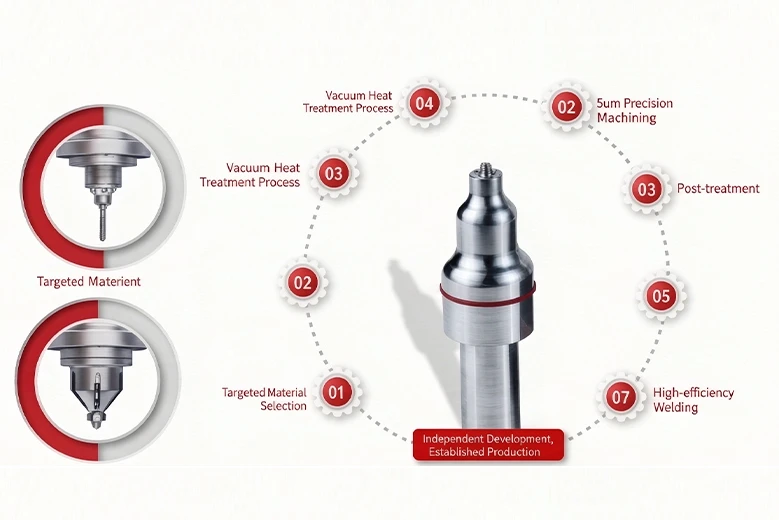
The Overlooked Heart of Friction Stir Welding: Inside a 1,000+ Tool Design Library
Friction stir welding has a paradox at its center. The physics — a rotating tool that plasticizes and forges metal without melting it — is elegant, widely published, and more than three decades old. The equipment is now sold by several vendors worldwide. Yet weld outcomes between two suppliers running identical machines on identical alloys can differ by a wide margin. The variable that explains most of the gap is the smallest, least glamorous part of the system: the stirring tool itself.
Sep.29,2026
"Need a Custom Cold Plate for Your Application?
Request a Free Thermal Design Review"
We provide high-strength, well-sealed core components for new energy vehicles that meet global automotive standards. Schedule a rapid technical consultation now.
Build a highly cohesive team of thermal management, special welding and precision manufacturing
QUICK LINK
QUICK LINK
LET’S CONNECT
LET’S CONNECT
+86 177 1265 6888 (WhatsApp)
+86 137 7167 8566 (WhatsApp)
Peter Fu peter@dyf-sz.cn
Eva Zhou deyanfumachinery@gmail.com
Building 3, No. 28 Xinchang Road, Suzhou Industrial Park, Suzhou City, Jiangsu Province